01
Available today
Existing cameras
RTSP and ONVIF cameras provide persistent site awareness without requiring a full infrastructure replacement.
Physical AI security
Tensor Dynamics Watch already turns existing cameras into AI investigators. We are extending the same incident, evidence, and human-decision workflow to drones and ground robots.
One governed incident chain
Physical AI is not a vague label here. At Tensor Dynamics, it is a security workflow with explicit authority, evidence, and product-maturity boundaries.
Available today
RTSP and ONVIF cameras provide persistent site awareness without requiring a full infrastructure replacement.
Available today
AI follows plain-language missions, investigates context, preserves evidence, and creates a traceable incident record.
Working prototype
The system proposes a next step and mission plan. An operator reviews evidence, safety limits, and routes before execution.
Prototype / next
Drones and ground robots accept governed missions in simulation; real-hardware integration and pilots are still in progress.
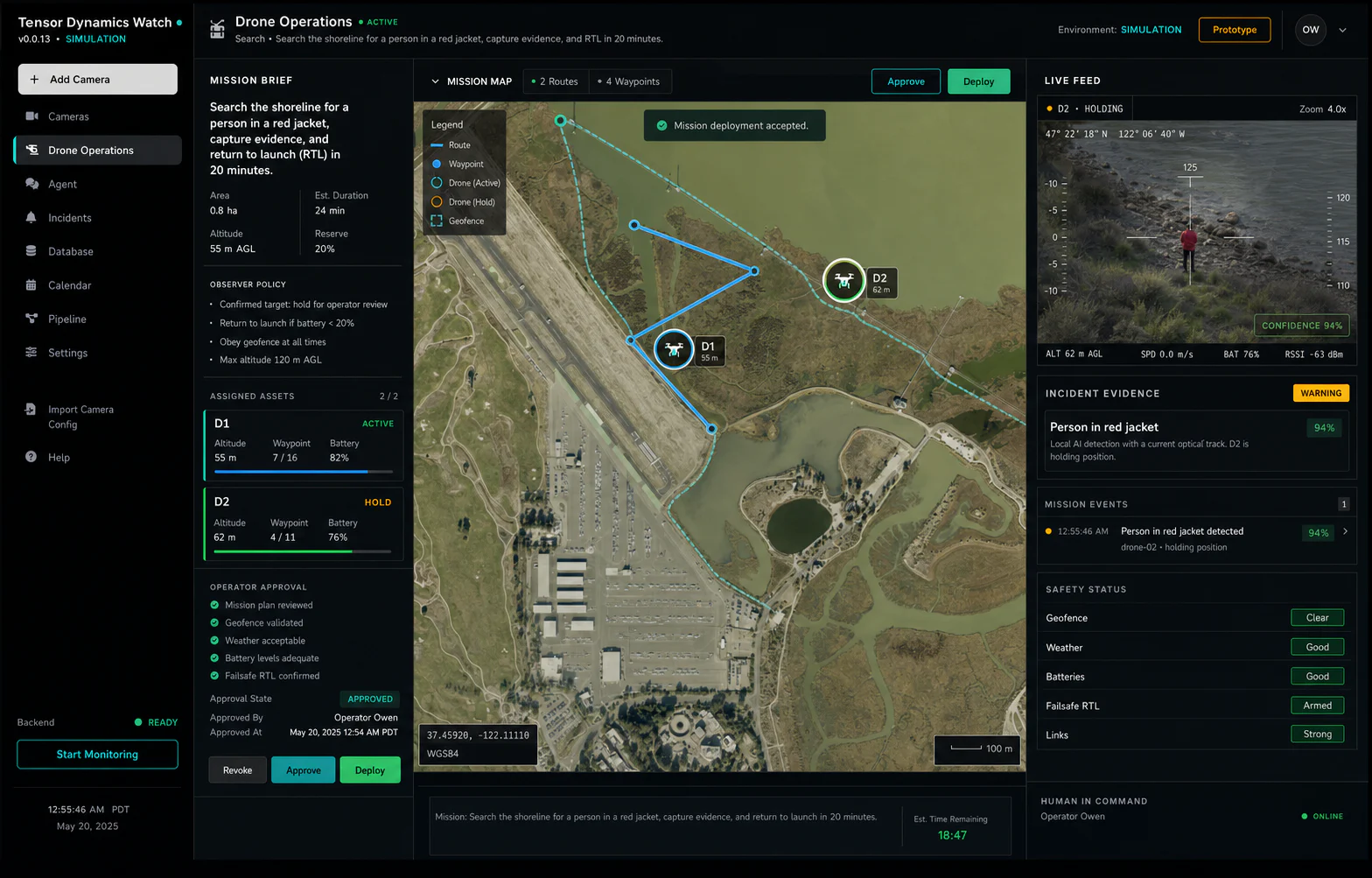
What the prototype does
Status: This is not a commercially deployed autonomous robotic-response system. Real-hardware integration and field pilots remain the next stage.
Safety and authority
High-risk physical actions require explicit operator approval.
Stop, hold, return, and manual-takeover controls do not depend on a new AI mission.
The desktop is not the flight authority; control stays with an edge controller or autopilot.
Incident, evidence, plan, approval, command, and outcome remain in one traceable record.
Product maturity
Compatible existing cameras, incident investigation, evidence history, alerts, and human final decisions.
Simulated vehicles, Watch-event handoff, mission planning, safety controls, and human approval.
Real-hardware integration, autonomous patrol, air-ground coordination, and multi-agent security operations.
FAQ
It connects perception from cameras and sensors with AI investigation, governed planning, human approval, and physical systems such as drones or ground robots.
Not yet as a commercially deployed hardware response system. Watch-event handoff, mission planning, safety controls, and human approval run in a working multi-robot simulator; real-hardware integration is underway.
Yes. Tensor Dynamics Watch works today as an AI monitoring and incident-investigation layer for compatible RTSP and ONVIF cameras.
No. High-risk physical actions require explicit operator approval, while vehicle safety and control authority remain with an external edge controller or autopilot.